Windows Vista startup process - Wikipedia. This article is about startup process in Windows Vista and later versions.

In Windows, what is 'Safe Mode' used for and why? How to boot into safe mode or VGA mode. Sometimes while changing video cards you can get Windows into such a bad state that it refuses to boot. This post will tell you to restart and boot into or directly reboot in Safe Mode in Windows 10/8 or Windows 7 easily, with Networking or any other option. Follow the instructions below to configure Windows to reboot directly into Safe Mode by making changes in the System Configuration utility, usually referred to as.

For other uses, see NTLDR. The startup process of Windows Vista, Windows Server 2. Windows. In this article, unless otherwise specified, what is said about . For Windows Vista, the boot sector loads the Windows Boot Manager (a file named BOOTMGR on either the system or the boot partition), accesses the Boot Configuration Data store and uses the information to load the operating system. Then, the BCD invokes the boot loader and in turn proceeds to initiate the Windows kernel. History. It is used by Microsoft's new Windows Boot Manager and replaces the boot. NTLDR. Boot Configuration Data are stored in a data file that has the same format as Windows Registry hives and is eventually mounted at registry key .
For UEFI boot, the file is located at \EFI\Microsoft\Boot\BCD on the EFI System Partition. For traditional BIOS boot, the file is at \boot\BCD on the active partition. These menu entries can include: Options to boot Windows Vista and later by invoking winload.
Options to resume Windows Vista and later from hibernation by invoking winresume. Options to boot a prior version of the Windows NT family by invoking its NTLDR. Options to load and to execute a volume boot record. Boot Configuration Data allows for third- party integration, so anyone can implement tools like diagnostics or recovery options. Boot loaders. In that respect, winload. NTLDR in prior versions of Windows NT.
Locate the section titled Boot Option on the System Configuration window. Here you can check the option titled Safe Mode. Notice that Minimal Safe Mode is the default. To reboot Windows 7 into safe mode with networking, run msconfig.exe. On the Boot tab, you can select "Safe boot" and there is a checkbox for networking. Many times in order to remove a piece of spyware or for troubleshooting and diagnostic purposes, you'll have to start Windows in Safe Mode. While in Safe Mode, only.
In UEFI systems, the file is called winload. The only difference is the alternate boot mode and the splash screen displaying . In UEFI systems, the file is called winresume. Advanced Boot Options.
/about/safemode-windows-vista-5-58070bd75f9b5805c2011065.jpg "How To Reboot In Safe Mode On Vista")

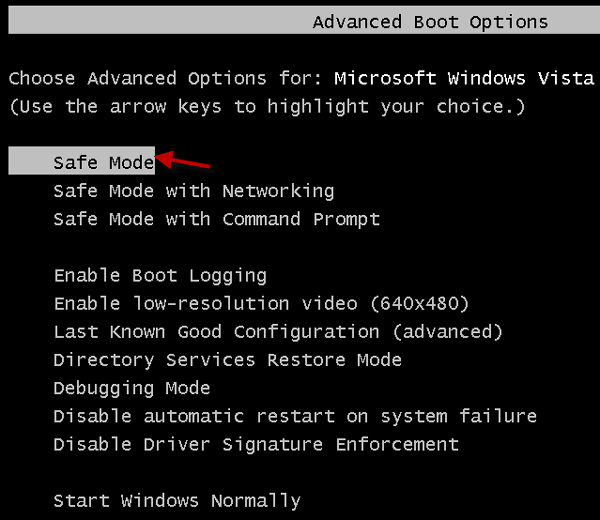
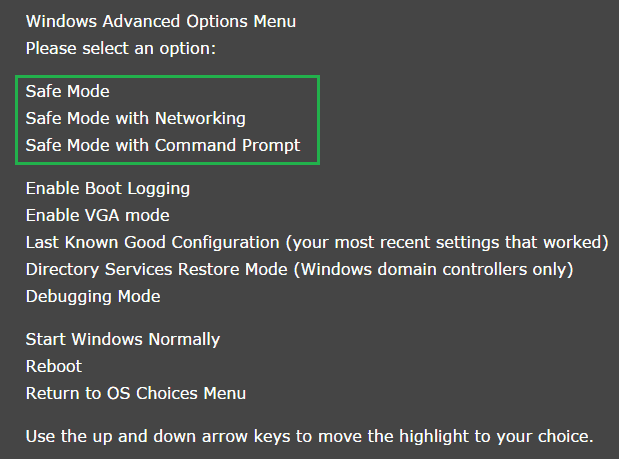
Due to the implementation of Hybrid Boot in Windows 8 and up, access to the Advanced Boot Options menu has been disabled by default. However, access is still possible with a BCD modification. These are the possible boot modes: Repair Your Computer - Boots Windows Recovery Environment (Win. RE or Windows RE)Safe Mode - Loads Safe Mode, a boot mode with minimal drivers and resources intended for malware removal or replacing faulty drivers. Safe Mode with Networking - Loads Safe Mode along with the network drivers. Safe Mode with Command Prompt - Loads Safe Mode with the Command Prompt as the shell instead of Windows Explorer.
Windows Explorer can still be loaded by typing explorer at the command prompt. Enable Boot Logging - Enables writing of ntbtlog. Enable low resolution video - Disables the default graphics driver and uses the standard VGA driver. Intended in case the user changed the resolution to an unusable level (i.
Intended for Registry corruptions. This mode is removed in Windows 8 and later. Directory Services Restore Mode - Boot mode used to reboot the Domain Controller in case it is not working as intended.
Debugging Mode - Boots while loading the kernel debugger. Disable automatic restart on system failure - Disables the auto- reboot function after a Blue Screen of Death is experienced. Disable early launch anti- malware driver - Allows malware- infected drivers to be loaded.
Disable Driver Signature Enforcement - Disables the kernel setting that prohibits unsigned drivers from loading. Start Windows Normally. The ABO menu is accessible by pressing rapidly or holding the F8 key before Windows boots.




/http%3A%2F%2Fph-live.slatic.net%2Fcms%2FPROJECT%20HERCULES%2Ftorque_long.jpg)
/http%3A%2F%2Fwww.ghostadventurescrew.com%2Fweb%2Fwp-content%2Fuploads%2F2014%2F06%2Fghost_ss_linda-vista-hospital_005_596x334.jpg)
/http%3A%2F%2Fwww.hwp.ru%2FTvtuners%2FPinnacle.usbvista%2FPinnacleusbvistakit-1.jpg)
/https%3A%2F%2Fae01.alicdn.com%2Fkf%2FHTB19LeiQVXXXXX3XVXXq6xXFXXXa%2FTenda-AC9-1200M-Smart-Dual-Band-802-11AC-2-4G-5GHz-Gigabit-Wireless-WiFi-Router-Repeater.jpg)