
For example, when you want to customize Windows UI and need to replace existing system files with a new one. You have to follow number of steps to take ownership and grant yourself full permission and control to access the file or folder. But now you can do it in a single step. You just need to download following zip file and extract it. You'll get a . REG file. Run the file and accept the confirmation: Download . It'll make you the owner of the file or folder and you can perform your desired operation on that file or folder.


An extra uninstallation registry script is also available in the ZIP file in case you want to remove the option from context menu. PS: If you want to know what kind of command does the context menu option . Just replace filename and foldername terms in the commands with the actual file name and folder name. NOTE: If you face any problem while taking ownership of a file or folder using context menu option, you can try to take the ownership manually using the method given in following tutorial.
How to start an Elevated Command Prompt in Windows 7 and Vista. A Command Prompt allows you to run programs, manipulate Windows settings, and access files by typing in commands that you wish to execute. To start a Command Prompt you simply need to type cmd. Start menu or click on Start, then Accessories, and then click on the Command Prompt icon. A window will appear, called the Command Prompt, that will open in your user profile folder and wait for you to issue commands. An example of this Command Prompt can be seen below: Default Command Prompt Window.
The problem with the standard Command Prompt is that any commands you run in it operate as if you do not have Administrative privileges. So you won't be able to run any commands or access any files that require these privileges. There are three methods that can be used to open an Elevated Command Prompt and I have outlined them both below. Method 1: Run As Administrator from shortcut.
Many times you need to take ownership of a file or folder in Windows. Use a Software Restriction Policy (or Parental Controls) to stop exploit payloads and Trojan Horse programs from running. When you use a Standard User account on. If I told you there was a public presentation and arguably demonstration of Windows 7, you probably wouldn’t believe me. Which is why I had to share this video with.
The first method is to launch the Command Prompt as an Administrator. This can be achieved by clicking on the Start menu, then selecting All Programs, and then Accessories. You will now see a shortcut labeled Command Prompt. Right- click on it and select Run as administrator as shown below.
I was able to make Airprint work with IOS 5 under windows!!! Installing an antimalware app and keeping it up to date can help defend your PC against viruses and other malware (malicious software). The differences in file and printer sharing in Windows Vista are the following: The default. How to Set Up a Standard User Account (or Limited Account) on Windows Vista and Windows 7 for Daily Use. One of my visitors heard about how surfing and working on.
Run as administrator. When you select Run as administrator a User Account Control prompt will appear asking if you would like to allow the Command Prompt to be able to make changes on your computer. User Account Control Prompt.

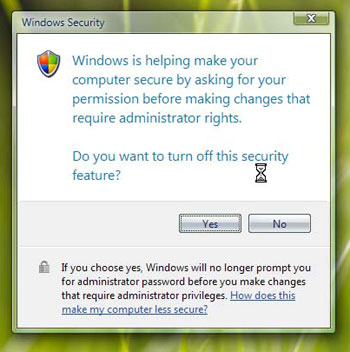
/about/windows-on-off-command-580730945f9b5805c23bf59f.jpg "How To Make Windows Vista Stop Asking For Permission")

Install JD Edwards EnterpriseOne 9.0 Demo/Standalone on Windows Vista (x86 / x64). There were many guys who were asking on how to install JD Edwards EnterpriseOne. TROUBLESHOOTING WINDOWS STOP MESSAGES Last updated October 18, 2007 Hold mouse here for list of most recent changes. Receive notice whenever this page is updated.
Click on the Yes button and you will now be at the Elevated Command Prompt as shown below. Elevated Command Prompt. Please note that the Elevated Command Prompt starts in the Windows System.
A Command Prompt allows you to run programs, manipulate Windows settings, and access files by typing in commands that you wish to execute. To start a Command Prompt.
C: \Windows\System. User Profile. In this Elevated Command Prompt you can now launch programs or access files that require Administrative privileges. Method 2: Use Ctrl+Shift+Enter to launch Cmd. It is also possible to launch cmd. Start Menu search field by using the Ctrl+Shift+Enter keyboard combination. To use this method, click on the Start menu and in the search field enter cmd as shown in the image below.
Start Menu search field. Once you type cmd, press the Ctrl+Shift+Enter keyboard combination and cmd. Run as Administrator. You will then see a User Account Control prompt asking if you would like to allow the Command Prompt to be able to make changes on your computer. Click on the Yes button and you will now be at the Elevated Command Prompt. Method 3: Create an Elevated Command Prompt Shortcut. If you find that you use the Elevated Command Prompt often and would like an easier way to launch it, you can make a short cut to it on your desktop or pinned to your Taskbar.
To do this you can click on the Start menu, then selecting All Programs, and then Accessories. You will now see a shortcut labeled Command Prompt. Right- click on it and either drag it to your desktop and copy it there, select Pin to Start Menu, or select Pin to Taskbar (Windows 7 only). Once the Command Prompt shortcut is where you want it, right- click on it and select Properties.
You will now be at a screen similar to the one below. As shortcut's advanced properties screen. At this screen put a checkmark in the box labeled Run as administrator, as shown above, and then click the OK button. Then click OK one more time to exit the shortcut's properties.
Now whenever you double- click on this shortcut it will automatically run the Command Prompt with elevated privileges. As always, if you have any questions regarding this procedure please ask us in our Windows 7 forum.


/http%3A%2F%2Fph-live.slatic.net%2Fcms%2FPROJECT%20HERCULES%2Ftorque_long.jpg)
/http%3A%2F%2Fwww.ghostadventurescrew.com%2Fweb%2Fwp-content%2Fuploads%2F2014%2F06%2Fghost_ss_linda-vista-hospital_005_596x334.jpg)
/http%3A%2F%2Fwww.hwp.ru%2FTvtuners%2FPinnacle.usbvista%2FPinnacleusbvistakit-1.jpg)
/https%3A%2F%2Fae01.alicdn.com%2Fkf%2FHTB19LeiQVXXXXX3XVXXq6xXFXXXa%2FTenda-AC9-1200M-Smart-Dual-Band-802-11AC-2-4G-5GHz-Gigabit-Wireless-WiFi-Router-Repeater.jpg)